



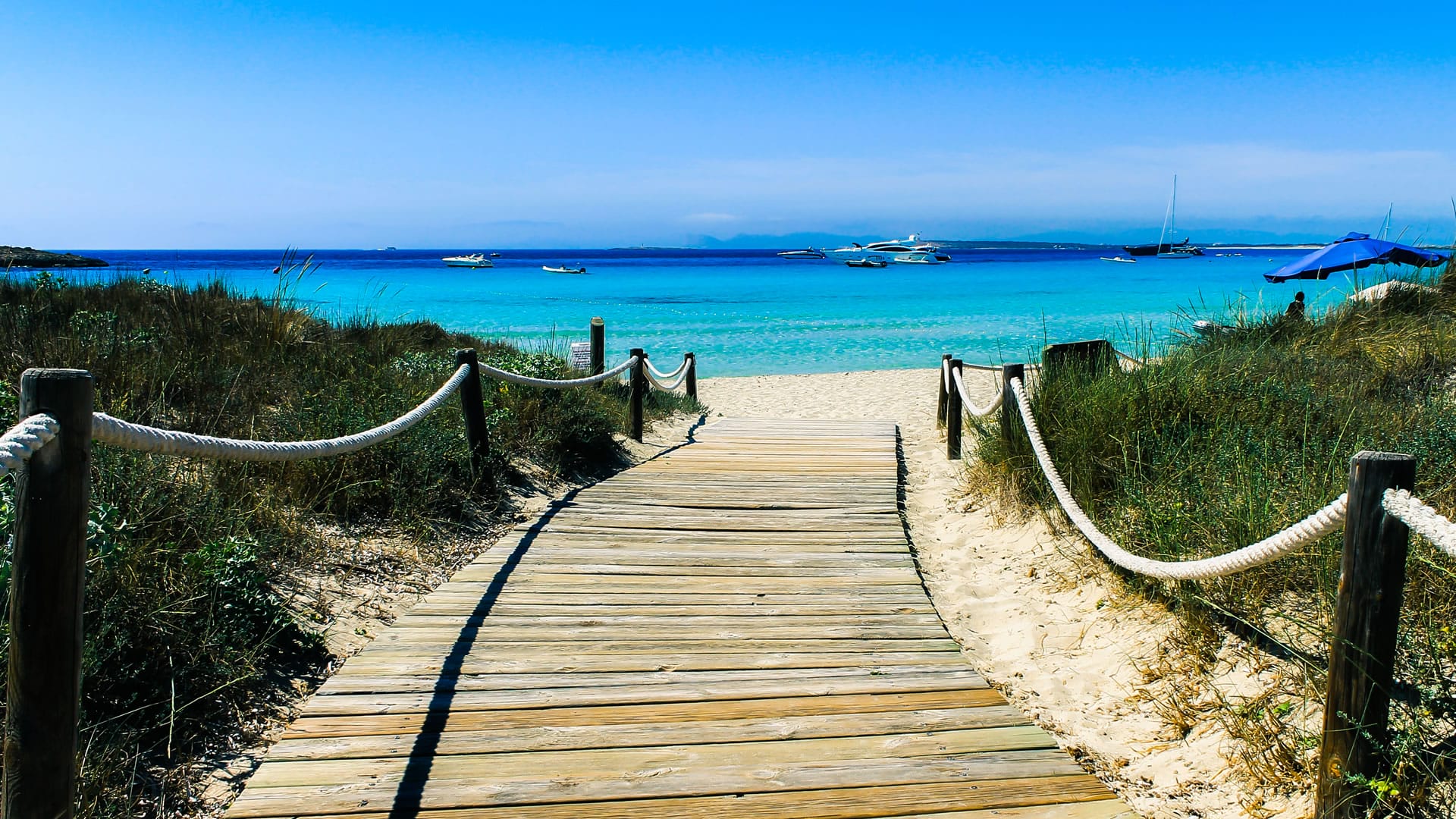
Formentera is often described as a destination for couples, for those seeking silence, for those who want to lose themselves in a sea that seems like the Caribbean. But there is another way to experience it, equally authentic and perhaps even more fulfilling: with children. Those who arrive on the island with young children discover a place that, if chosen carefully, can become the vacation the whole family will talk about for years. The secret lies in knowing which beach to choose, because not all are the same when traveling with children.
What is a Child Friendly Beach in Formentera
Before jumping into places, it’s good to know what to look for. In Formentera, the sea is extraordinary everyplace due to the Posidonia oceanica, the protected marine plant that filters the water and keeps it crystal clear. But not all beaches have the same characteristics. For families with small children, three things are especially important: the depth of the water near the shore, the quality of the seabed — better sandy than rocky — and the presence of basic amenities such as shade, restrooms, and some refreshment points nearby.
To these, an often underestimated factor is added: the wind. Some areas of the island, like the Migjorn side, are more exposed and can have waves and currents that are difficult for small children to handle. Choosing the right beach also means taking this into account.
Ses Platgetes: the best choice for the little ones
If there is a beach in Formentera designed — almost by nature — for families with small children, it is Ses Platgetes, in the Es Pujols area. Here, the sea is very shallow for dozens of meters from the shore, the water is very calm, and the seabed is sandy and even. Children can walk, play, and swim without parents having to hold their breath.
Why it works so well
Because Ses Platgetes is in a sheltered position it is protected from the strongest winds and therefore the sea is nearly always flat and predictable. The proximity to the center of Es Pujols — the liveliest village on the island — means that bars, ice cream shops, restaurants, and supermarkets are just a few minutes’ walk away. For those traveling with children, this logistics makes a huge difference.
Es Pujols: the village beach
Right next to Ses Platgetes is the beach of Es Pujols, larger and slightly more crowded, but still suitable for families. Here too, the sea is calm, the seabed is shallow and sandy, and the presence of sunbeds and umbrellas for rent — not always guarantyd in Formentera — is a real convenience when you have a stroller, bags, toys, and everything else you bring along with the kids.
Es Pujols also has the advantage of being accessible by public transport, a practical solution for those who do not want to rent a scooter and prefer to move around more calmly.
Illetes and Llevant: the most beautiful sea, with a little extra care
Those who arrive in Formentera with children do not want to miss out on the island’s most famous beaches, and rightly so. Illetes and Llevant are among the most beautiful places in the Mediterranean and can be enjoyed with the family, with a few precautions.
Illetes
The beach of Illetes has incredible water — flat, turquoise, very shallow — which makes it suitable even for very small children. The western side, the more sheltered one, is generally calmer. The critical point is the logistics: there are no services in the immediate vicinity, so you need to arrive equipped with water, food, and everything necessary. Access during the high season can be complicated, but in May or June the situation is much more manageable.
Llevant
Llevant is the opposite side compared to Illetes, facing east. The sea here is equally clear but slightly more choppy on windy days. It is a long and uncrowded beach, perfect for older children who love to run, play in the sand, and go snorkeling in shallow waters.
Migjorn: for older children and active families
The Migjorn beach is the longest beach in Formentera, a golden sandy stretch that runs for several kilometres along the southern side of the island. It is a wonderful beach, but different from those in the north: the sea here is more open, the waves can be more present, and the seabed drops more steeply compared to Ses Platgetes or Illetes.
For younger children, it can be less ideal on windy days. But for families with older children — from 7-8 years old and up — Migjorn is one of the most beautiful experiences on the island. There is infinite space, several beach bars where you can eat fresh fish or have a snack, and a relaxed atmosphere that invites you to stay all day.
Cala Saona: the most scenic cove on the island
Technically Cala Saona is a cove, and not an open beach, which makes it naturally sheltered and with calm waters. It is one of the most photographed spots in Formentera, with its reddish cliffs descending into an emerald green sea. For families looking for something more intimate and picturesque, it is a must-visit.
The small size and natural protection of the cove make it suitable even for small children, as long as you arrive early because the available space is limited. There is a small bar-restaurant, which solves the lunch problem without having to bring everything from home.
Practical Tips for Families
Organizing a day at the beach in Formentera with children requires a bit more planning compared to a destination with more structured services. The island’s beaches are mostly natural and poorly equipped, which is part of their charm but can complicate life with small children.
When to go
May and June are the ideal months for families: the sea is already warm enough for swimming, the beaches are free, and the temperature is not yet the suffocating one of August. July and August are beautiful but crowded months, and the heat during the central hours of the day can be challenging for younger children.
How to get around
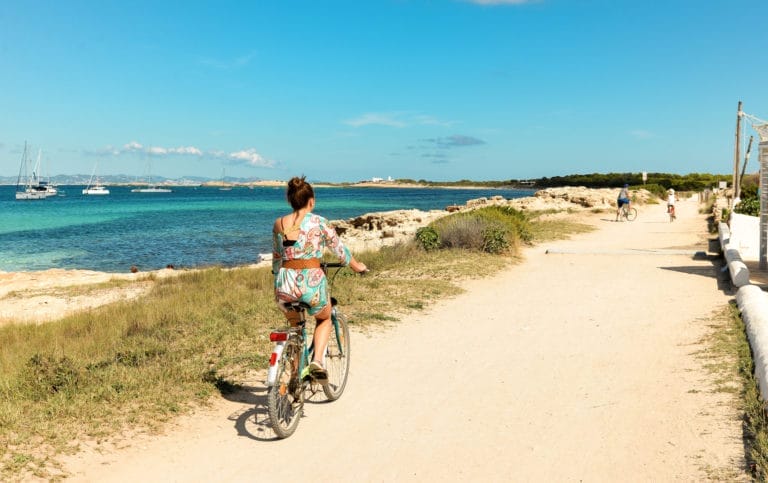
For families, the most convenient way to reach the beaches is to rent a car or a quadricycle. Bicycles, although being the symbol of Formentera, can be tiring with children in tow, especially on the roads leading to Illetes or La Mola. Public busses exist and connect the main points of the island, but with frequencies that require a bit of flexibility.
What to bring
High-protection sunscreen, plenty of water, a snorkel for older children, water shoes for mixed bottoms, and a thermal backpack for lunch are the essential items. On many beaches, there is no natural shade, so a lightweight beach umbrella can make a difference during the hottest hours.
Formentera with children is not only possible: it’s an experience that is worth every logistical effort. Choosing the right beach is the first step to turning a simply beautiful vacation into something unforgettable.