



Schooling in Formentera: A Guide for Families Relocating to the Smallest Balearic Island
It may be one of the most idyllic places in Europe to raise a child — but before you pack your bags, there are a few things about education on this tiny island that every parent needs to know.
Formentera is, in many ways, the Mediterranean dream distilled to its purest form. Turquoise water, pine-scented air, a pace of life that has no particular interest in hurrying. For families dreaming of a life less ordinary, the pull is real and understandable. But the question every parent asks — often before they’ve even booked the viewing trip — is this: what about the schools?
The honest answer is that Formentera’s educational landscape is small, entirely public, genuinely community-oriented, and facing some structural challenges that are important to understand before you commit to a move. This is not a reason to walk away — but it is a reason to go in with clear eyes.
Understanding the Scale
Formentera is the smallest inhabited island in the Balearic Islands — a place of extraordinary beauty, but also of real logistical limitations. In the 2025–2026 school year, the island counted just over 1,200 enrolled students across all levels of education, from nursery through to secondary school. For context, Ibiza has over 19,000. This is island schooling at its most intimate.
There are no international schools here. There is no British curriculum, no French lycée, no Montessori alternative. What Formentera offers is a tight network of public schools, shaped by the rhythms and culture of a small Mediterranean island community — and, increasingly, by the challenges that come with it.
The Schools: Who They Are
The island’s educational network is modest but complete, covering every stage from infancy through to secondary education.
Early Years (0–3): The island runs two public nurseries — Escoleta Sa Miranda in Sant Francesc Xavier, and Escoleta Sant Ferran — for children aged zero to three. In recent years, the Consell de Formentera has made a concerted effort to make these places free of charge for all families, a genuinely positive development for new residents.
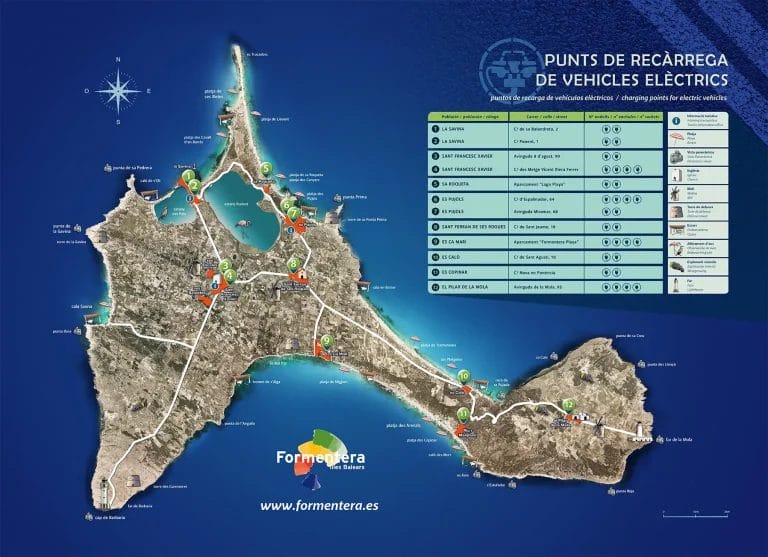
Primary Schools: There are three public primary schools on the island: CEIP Mestre Lluís Andreu in Sant Francesc Xavier, CEIP Sant Ferran in Sant Ferran de ses Roques, and CEIP El Pilar in La Mola. Each serves the community closest to it, reflecting the island’s dispersed geography. The Escola Infantil Verge Miracolosa, a faith-based complementary school in Sant Francesc, provides an additional option at early years level.
Secondary School: For secondary education, there is a single institution — IES Marc Ferrer, a public secondary school in Sant Francesc Xavier. All teenagers on the island converge here for their secondary years. It is, in the truest sense, the island’s school.
Music & Arts: Beyond the standard academic track, the island also hosts the Escola Municipal de Música i Dansa de Formentera — a school of music and dance, which offers lessons and organises entrance assessments for new students each year. For families with artistically inclined children, this is a genuine gem.
The Language Question
As with all public schools in the Balearic Islands, teaching in Formentera takes place primarily in Catalan and Spanish. Catalan — specifically the local Ibizencan dialect, eivissenc — is the language of instruction in most subjects, with Castilian Spanish also present throughout. English is taught as a foreign language but is not a medium of instruction.
For families whose children do not yet speak either language, this is the single most important practical consideration before moving. Young children — particularly under the age of 10 — typically adapt with remarkable speed, and immersion in a small school community can be extraordinarily effective. Older children, especially teenagers, may find the transition more challenging, and parents should plan accordingly, potentially budgeting for private language tutoring in the early months.
A Genuine Challenge: Teacher Stability
One of the realities of schooling in Formentera that is rarely discussed openly — but which families deserve to know — is the ongoing difficulty the island faces in retaining teachers.
Being the smallest and most remote of the Balearic Islands, Formentera is routinely one of the last postings teachers choose. The combination of triple insularity, a severe shortage of affordable housing, and the distorting pressure of the tourism economy makes it genuinely hard to attract — and keep — qualified staff. Each school year begins with uncertainty about how many teachers will arrive, how many will see out the full year, and how many will leave mid-term.
At IES Marc Ferrer, only around a third of the teaching staff hold permanent positions. The remainder changes constantly, making it difficult to build and sustain long-term educational projects. Every September, school management teams find themselves essentially restarting from scratch — explaining how the institution works, rebuilding relationships, re-establishing continuity for students who have already formed bonds with teachers who have since moved on.
This is not a failing of the teachers themselves — many arrive with tremendous energy and commitment. It is a systemic issue rooted in Formentera’s housing crisis and its status as one of the most expensive places to live in Spain. Parents should be aware of it and factor it into their expectations.
What the Island Is Doing About It
The picture is not entirely bleak, and it would be unfair to leave it there. Investment in Formentera’s schools has been growing steadily.
IES Marc Ferrer is currently undergoing a significant expansion — a nearly €2 million project incorporating eight new teaching spaces, including six classrooms and two workshops, designed to meet the island’s current and future needs. At CEIP El Pilar in La Mola, construction of a new dining hall and additional facilities is in the pipeline, while improvements to the roof at CEIP Sant Ferran and the sporting facilities at CEIP Mestre Lluís Andreu are also underway.
The Consell de Formentera also provides grants and scholarship support to help offset the practical disadvantages of island life — including insularity subsidies for students who need to leave the island entirely for higher or specialised education. It is a practical and meaningful form of support for families planning for the long term.
Life Beyond the Classroom
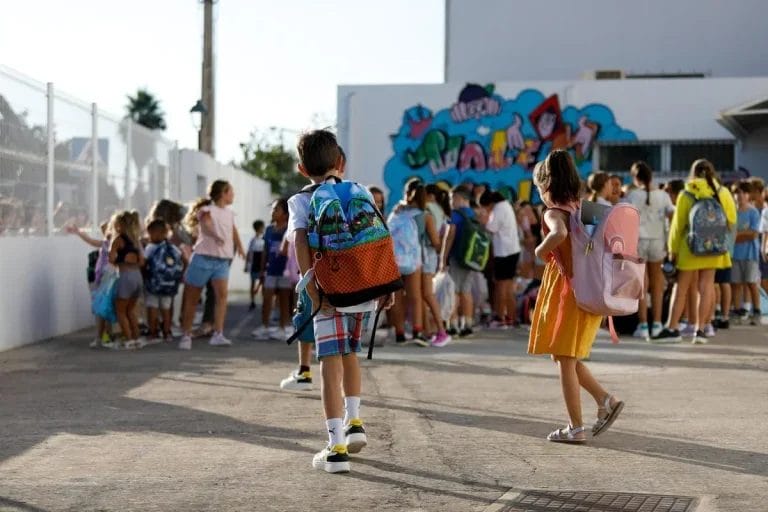
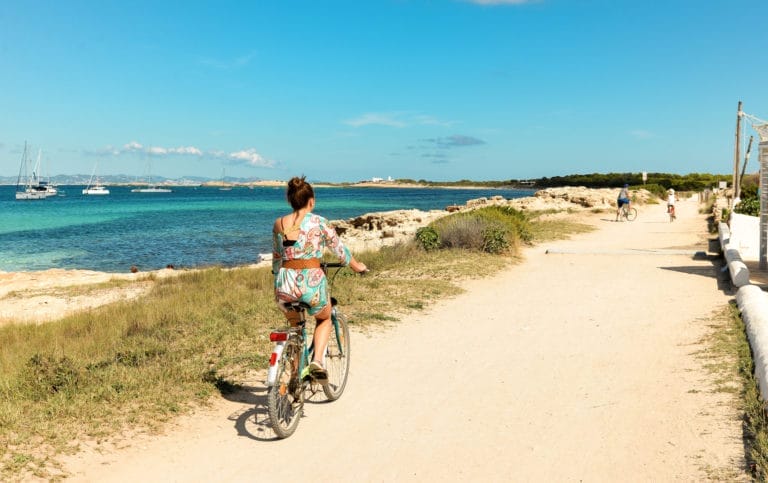
It’s worth stepping back and considering what Formentera itself offers as an educational environment — because in many respects, the island is the curriculum. Children growing up here learn to swim in transparent water, to understand the seasons, to move freely between landscapes and communities in a way that children in cities rarely can.
The sense of community in Formentera’s schools is real and deeply felt. In a school where everyone knows everyone, a child is never anonymous. Teachers, parents, and students are bound together by the smallness of island life in ways that create genuine bonds — and a kind of social education that no formal curriculum can fully replicate.
Practical Considerations Before You Move
A few things worth having squared away before arriving with children:
Language preparation. If your children speak no Spanish or Catalan, even a few months of basic Spanish before the move will make an enormous difference to their first weeks at school. Children are resilient, but a little preparation goes a long way.
Secondary school planning. IES Marc Ferrer is the only secondary option on the island. For families whose teenagers may later wish to pursue international qualifications — A-Levels, the French Baccalaureate, or the IB — access to those tracks would require a move to Ibiza or the mainland. It is worth planning for this horizon from early on.
Higher education. There is no university on Formentera. Students seeking higher education will need to leave the island — typically travelling to Ibiza, Mallorca, Barcelona, or further afield. The Consell’s insularity grants help ease this transition financially.
Private tutoring. A small network of private tutors operates on the island, particularly for English language support. It is worth identifying options before you arrive, especially if your children are joining mid-year.
The Bottom Line
Formentera is not the right choice for families seeking an international school environment, a British curriculum, or a multilingual private school experience. For that, Ibiza — just a short ferry ride away — remains the natural answer.
But for families genuinely committed to integrating into island life, learning the local languages, and raising children in one of the most strikingly beautiful natural environments in Europe, Formentera’s schools offer something real: community, intimacy, and a connection to place that is increasingly rare. The challenges are genuine, but so is the reward.
Moving to Formentera with children is not the easy path. It is, for those who embrace it fully, something better.
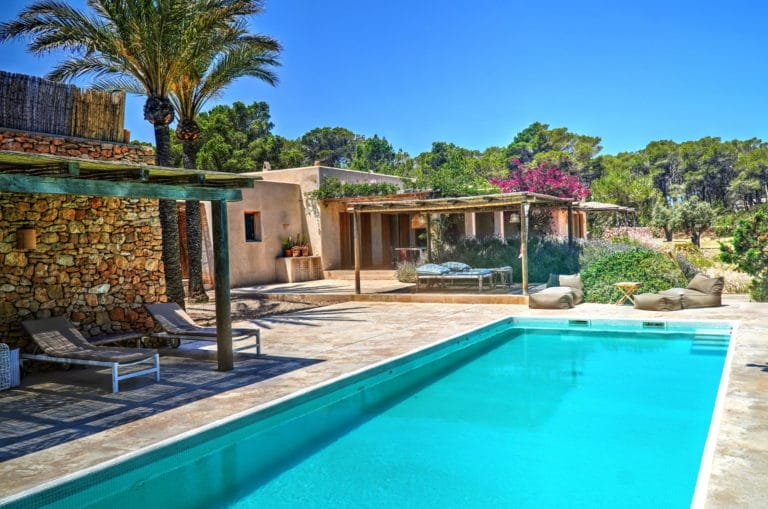
Thinking of making the move? We’re happy to advise on locations, commute times to schools, and family-friendly properties across the island.