



Frequently asked questions about Formentera
How much does a week in Formentera cost?
The budget for a week in Formentera varies greatly depending on the season and travel style. In high season (July and August), a couple can spend between 2,500 and 5,000 euros including accommodation, the ferry from Ibiza, meals, scooter rental and a few evenings out. In low or shoulder season, the same trip can cost between 1,200 and 2,500 euros. Formentera is one of the most expensive destinations in the Balearic Islands, but with good planning it is possible to keep costs under control without sacrificing quality.
How much does a coffee cost in Formentera?
A coffee at the counter in the bars of Sant Francesc or La Savina generally costs between 1.50 and 2 euros. In seafront venues or in the chiringuitos near the most famous beaches, such as those close to Ses Illetes, the same coffee can reach 3 or 4 euros. It is not an enormous amount, but it is indicative of the general price level on the island, where anything close to the beach carries a premium compared to inland areas.
How much does a pizza cost in Formentera?
A pizza in a standard pizzeria in Formentera costs between 12 and 18 euros. In seafront restaurants or more upscale venues, especially around Es Pujols or along the main beaches, prices can rise to 20–25 euros. For a good meal without overspending, it is worth exploring the restaurants of Sant Francesc Xavier, the island’s main town, where prices are more reasonable and quality is often higher.
What is the best month to visit Formentera?
The best month to visit Formentera is June, or the first half of September. During these periods the sea is warm, the beaches are lively but not overcrowded, and prices are slightly lower than at the peak of July and August. Those looking for maximum tranquillity can choose May or October: the weather is still pleasant, many venues are still open, and prices drop noticeably.
Is Ibiza or Formentera more expensive?
Formentera is generally more expensive than Ibiza in terms of accommodation and dining. Being a smaller island with a limited supply of hotels and rental properties, prices tend to be higher, especially in high season. Formentera has no real nightlife comparable to Ibiza, so spending on evenings out is lower, but almost everything else costs more: food, beach services, rentals.
Which is the cheapest of the Balearic Islands?
Among the main Balearic Islands, Menorca is generally the least expensive, followed by Mallorca outside of peak season. Formentera sits at the opposite end of the scale, alongside the most exclusive parts of Ibiza. Travellers on a tighter budget would do well to consider Menorca, which offers beautiful beaches, a relaxed atmosphere and significantly more affordable prices, while still maintaining a high quality of life.
Where is the best place to stay in Formentera?
For those looking for a balance between location, amenities and price, Sant Francesc Xavier is the most practical choice: it is the island’s administrative centre, has good restaurants and shops, and is well connected to the rest of Formentera. Es Pujols is the most lively and tourist-friendly area, ideal for those who want to be close to the beach and evening venues. Those who prefer complete peace and quiet can opt for one of the houses or hotels in the rural interior, reaching the beaches by bike or scooter.
Why do VIPs go to Formentera?
Formentera attracts celebrities and wealthy visitors thanks to a combination of factors that is hard to find elsewhere: some of the clearest waters in the Mediterranean, a relaxed and discreet atmosphere, no airport (and therefore no mass charter tourism), and a long tradition of respect for nature and privacy. The island has no large chain hotels or loud nightclubs, making it an ideal retreat for those who truly want to disconnect without being recognised at every corner.
How much does it cost to enter Ses Illetes?
Access to Ses Illetes beach is free, as is access to all beaches in Formentera and Spain in general. There is no entrance fee. However, since 2016 a vehicle access levy has been in place for private cars entering protected natural areas during high season, with the amount updated periodically. Those arriving on foot, by bike or by public transport pay nothing. The beach is therefore accessible to everyone, but the cost of sunbeds and umbrellas at the nearby chiringuitos can be significant.
How much do sunbeds and umbrellas cost in Formentera?
Renting two sunbeds and an umbrella in Formentera costs between 25 and 50 euros per day depending on the beach and the chiringuito. At the most exclusive spots such as Ses Illetes or Illetes Nord, front-row positions can reach 60–80 euros. Not all beaches have organised facilities: many natural areas and smaller coves are completely free, and many visitors prefer to bring their own towel and umbrella.
Are beaches in Formentera free?
Yes, beaches in Formentera are public and access is always free. Spanish law guarantees free access to the sea throughout the national territory. What you pay for, optionally, is the use of services provided by chiringuitos and beach clubs: sunbeds, umbrellas, showers, lockers. Natural beaches and more remote spots have no paid services whatsoever and are frequented by those who prefer a more basic approach to their time by the sea.
How much does it cost to rent a scooter in Formentera?
Renting a scooter in Formentera costs on average between 35 and 60 euros per day in high season, with prices dropping for multi-day rentals. A 50cc scooter is the most affordable option and perfectly sufficient for getting around the island at a leisurely pace. Those who want more power for the climbs up to La Mola can opt for a 125cc, at a slightly higher cost. It is advisable to book in advance during July and August, when available vehicles tend to run out quickly.
Can you get around Formentera by bike?
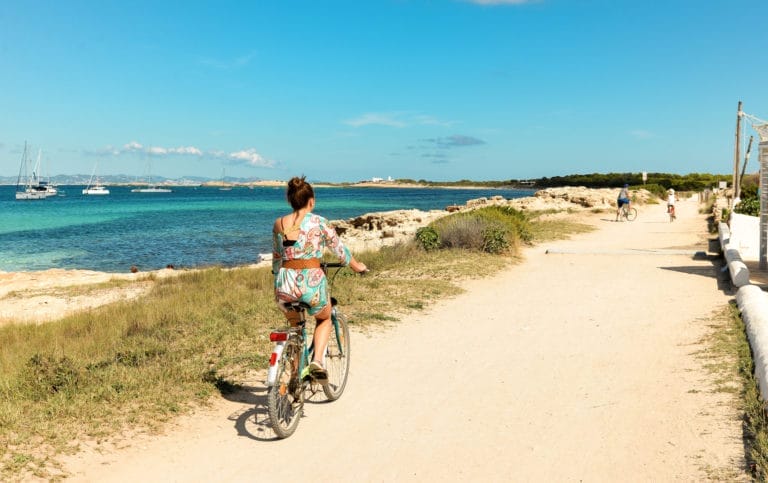
Yes, Formentera is one of the most bike-friendly islands in the Mediterranean. The cycle path network is among the most developed in the Balearics and covers much of the island, connecting the main beaches, villages and scenic viewpoints. The terrain is mostly flat, with the exception of the climb up to La Mola. Renting a bike is easy and affordable, with prices starting from around 10–15 euros per day. For many visitors, exploring Formentera by bike is the most authentic and enjoyable way to discover the island.
Are the beaches in Formentera equipped with facilities?
Formentera’s beaches offer very different levels of service. The most visited ones, such as Ses Illetes, Migjorn and Es Pujols, have chiringuitos, equipment rental, showers and toilets. The more remote and natural beaches, such as some coves along the southern coast or the wilder stretches of Llevant, are completely devoid of services. This variety is one of the island’s strengths: you can choose between the comfort of an organised beach club and the complete solitude of a cove reachable only on foot or by boat.
What are the most beautiful beaches in Formentera?
Formentera is home to some of the most beautiful beaches in the Mediterranean. Ses Illetes is the most famous, with crystal-clear water and posidonia seagrass beds that evoke the Caribbean. Llevant is its natural extension on the opposite side of the peninsula, quieter and less crowded. Migjorn is the longest beach on the island, with calm waters and several wild stretches. Cala Saona, on the west coast, is a small bay framed by reddish cliffs and is considered one of the most romantic spots on the island. Es Caló de Sant Agustí is popular with divers for its rich seabed.
What are the secret beaches of Formentera?
Beyond the well-known beaches, Formentera hides several less visited corners. The area of Es Rajolí on the north-west coast offers small rocky coves that are almost always deserted. The stretches of Migjorn far from the chiringuitos, accessible only on foot through paths in the Mediterranean scrubland, are much appreciated by regular visitors to the island. Some small beaches reachable by kayak or boat along the La Mola coastline also offer moments of absolute solitude, especially in September and October.
Which is the most beautiful beach in the Balearic Islands?
It is a question with no single answer, but Ses Illetes in Formentera consistently appears in lists of the most beautiful beaches in Europe in international rankings. The water is an intense turquoise, the posidonia oceanica seabed guarantees exceptional clarity, and the sand is fine and pale. Menorca has equally beautiful but wilder beaches, while Mallorca offers greater variety. Formentera, however, has a concentration of natural beauty that is hard to match within such a small territory.
What is the most famous club in Formentera?
Formentera has no nightclubs in the traditional sense of the word. The island is deliberately free of the frenetic nightlife that characterises Ibiza. The most iconic venue is the Blue Bar, near Migjorn beach, a legendary spot frequented since the 1970s, known for its sunsets and live music. Many visitors round off the evening with dinner at one of the restaurants in Es Pujols or Sant Francesc, before turning in early. Those who want to dance until dawn take the ferry to Ibiza.
How much does the ferry to Formentera cost?
The ferry from Ibiza to Formentera costs on average between 20 and 30 euros per person each way, depending on the company and the season. Currently, the round-trip ticket is priced at 60.60 euros per person. In high season prices rise and it is advisable to book in advance, especially on weekends in July and August when ferries fill up quickly. The crossing takes about 30 minutes on the fast boats and around one hour on the slower car ferries. Taking a vehicle on board carries a significant additional cost.
Can you take a car to Formentera?
Yes, it is possible to take a car to Formentera by ferry from Ibiza, but it is not recommended in high season. The cost of loading a vehicle is high, and the island has introduced traffic restrictions in protected areas during the summer months. Many visitors prefer to leave their car in Ibiza and travel to Formentera on passenger ferries, then rent a scooter or bike directly on the island. This is a more economical, more practical and more environmentally friendly solution.
Does Formentera have an airport?
No, Formentera has no airport and there are no plans to build one. The only way to reach it is by sea, almost always departing from Ibiza. This is one of the main reasons the island has remained relatively protected from mass tourism: it cannot be reached by direct low-cost flights, which naturally selects the type of visitor. The absence of an airport is seen by most residents as something to protect, not as a limitation.
Can I have a barbecue in Formentera?
It depends on the time of year. Formentera follows the Balearic Islands’ wildfire prevention regulations, which strictly control the use of open fire outdoors, including barbecues.
From 1 April to 15 October, the high wildfire risk season is in force, during which lighting any kind of fire — including charcoal and wood barbecues — is prohibited in forest areas, public recreational zones, and anywhere within 50 metres of woodland. Notably, this ban starts on 1 April in Formentera and Ibiza, earlier than in Mallorca and Menorca where it begins on 1 May, due to the drier spring conditions typical of the Pityusic Islands.
From 16 October to 31 March the seasonal ban is lifted, and barbecues are once again permitted, provided you follow standard safety precautions and any local regulations in force.
Bear in mind that even outside the banned period, the daily “Alerta Foc” monitoring system published by the Balearic Government can impose additional restrictions if weather conditions are particularly dangerous. At the highest alert level (Alerta Foc 4), all previously granted authorisations are automatically suspended.
Fines for breaching these rules can be substantial, and if a fire is caused through negligence, criminal liability may apply.
If you are visiting Formentera in summer and want to cook outdoors, the safest option is to use an electric griddle or a gas barbecue, always making sure you are at a safe distance from any woodland or Mediterranean scrub.
How do you get to Formentera from abroad?
To reach Formentera from abroad you must first fly to Ibiza, with direct flights available from many European airports during the summer season, and then take the ferry to Formentera. The crossing takes about 30 minutes on the fast boats. In low season direct flights to Ibiza are scarce, and a stopover in Barcelona, Madrid or Palma de Mallorca may be necessary. Ibiza airport is about 10 minutes from the port by taxi.
When do restaurants and venues open in Formentera?
Most restaurants, chiringuitos and businesses in Formentera are open from May to October. Outside this period the island quietens down considerably and many establishments close. In winter, only the venues frequented by locals remain open, mainly in Sant Francesc Xavier. Those visiting Formentera between November and March should be aware that the gastronomic and tourist offer is very limited, although the island has a particular charm during this silent season.
Which island is known as the nudist island?
Formentera has historically held this reputation, consolidated from the 1970s onwards when hippies and Northern European tourists began visiting and practising naturism openly. Some beaches on the island, particularly in the Llevant area and certain stretches of Migjorn, are still traditionally frequented by naturists. However, calling Formentera the nudist island would be reductive: it is above all an island of extraordinary natural beauty, visited by an extremely diverse range of people.
Is nudism legal in Spain?
Yes, nudism is legal in Spain. The practice has been permitted throughout the country since 1978, without the need for designated beaches or zones, although in practice it is mainly exercised on recognised naturist beaches or in places where local tradition makes it socially accepted. No law prohibits being without clothing on a Spanish public beach, provided no situations arise that disturb public order. The Balearic Islands in general, and Formentera in particular, have a very liberal culture in this regard.
Can you go topless on the beaches of Formentera?
Yes, topless sunbathing is completely accepted and widely practised on all beaches in Formentera, as throughout Spain. There are no legal or social restrictions whatsoever, and nobody will find it strange or inappropriate. Formentera has a tradition of great personal freedom and mutual respect dating back to the hippy community of the 1970s, and this is still reflected today in the relaxed and non-judgmental atmosphere on its beaches.
Are there naturist hotels in Formentera?
Formentera has no dedicated naturist resorts as found in other European destinations, but some accommodation in the Llevant and Migjorn areas has historically been frequented by naturists and offers a discreet and welcoming environment. Naturist practice on the island is more relaxed and informal than elsewhere: it does not concentrate in specific facilities but spreads naturally across the less crowded beaches and areas. Those looking for explicitly naturist structures would be better served by destinations such as Cap d’Agde in France or certain areas of the Costa Brava.
How should you behave on a naturist beach?
On a naturist beach there are some unwritten rules that are good to know. First of all, avoid staring at other bathers: naturism has nothing sexual about it and persistent glances are considered rude. It is good practice to sit on a towel when using seats or shared facilities. Photographing other people without their explicit consent is absolutely forbidden. In general, mutual respect is the fundamental principle: you behave exactly as you would on any other beach, simply without clothing.
What is the difference between a nudist and a naturist?
Although the two terms are often used interchangeably, there is a distinction. Naturism is a philosophy of life that embraces contact with nature, a healthy lifestyle and respect for the environment, of which nudity is only one expression. Nudism refers more simply to the practice of being naked, without necessarily implying a broader philosophical outlook. In practice, those who frequent the naturist beaches of Formentera may identify with either term, but the atmosphere is always one of respect for nature and for other people.
How do you avoid having your phone stolen at the beach?
Formentera has a very low crime rate compared to other Mediterranean tourist destinations, but it is always wise to take a few basic precautions. The simplest solution is to leave valuables in the safe at your hotel or apartment. If you bring your phone to the beach, avoid leaving it unattended while swimming: you can ask a neighbouring sunbather to keep an eye on it, or use a waterproof case to take it into the water with you. Some beach bags with hidden locks are also a good solution for those who want complete peace of mind.
Which island can nobody visit?
In the waters near Formentera lies S’Espalmador, a small private island of about 4 square kilometres, accessible only by boat. Technically it is not forbidden to approach its beaches by sea, but the island is privately owned and access to the interior is restricted. It is known for its lagoon of very shallow water and for its therapeutic mud. During summer many boats anchor nearby, making this area one of the most scenic spots in the Pityusic archipelago.
What do you eat in Formentera?
The cuisine of Formentera is strongly influenced by Balearic and Mediterranean tradition. Fresh fish takes centre stage: bullit de peix, a fish and potato broth served with alioli sauce, is the most traditional dish. Lobster prepared in the Menorcan style, with tomato and onion, is a speciality also common in Formentera. Local cheeses, bread with tomato and olive oil (pa amb oli), grilled vegetables and barbecued meats round out a simple but high-quality gastronomic offer. The island also has several international restaurants, especially in the more tourist-oriented areas.
Is Formentera suitable for families with children?
Yes, Formentera is an excellent destination for families with children. The water is shallow, calm and crystal-clear along many stretches, making it safe even for the very young. The atmosphere is tranquil, free of heavy traffic and noisy nightlife. Family-friendly accommodation is available, though in high season it is essential to book well in advance. The island also lends itself to bike rides, boat trips and snorkelling, activities enjoyed by children and teenagers of all ages.
Is Formentera dog-friendly?
Formentera is generally welcoming towards dogs, but it is important to know that on the main beaches animals are not permitted during the bathing season, roughly from June to September. There are some beaches and specific areas where dogs are tolerated or explicitly allowed, and many walking trails and natural paths are accessible with pets. Several accommodation options accept dogs by prior arrangement. It is always advisable to check the property’s policy in advance and find out about pet-friendly areas before travelling.
How big is Formentera?
Formentera is the smallest of the four main Balearic Islands: it has an area of approximately 83 square kilometres and a maximum length of about 19 kilometres. Despite its small size, the landscape is remarkably varied: from the lagoons and sandy beaches of the north to the high cliffs of La Mola in the east, from the salt flats to the juniper forests of the interior. The island can be toured almost entirely in a single day by scooter, but to explore it properly at a relaxed pace you need at least four or five days.
How many people live in Formentera?
Formentera has around 12,000 permanent residents, a number that multiplies many times over in summer, reaching peaks of 80,000–100,000 presences. This disproportion between residents and tourists is one of the main challenges the island faces in terms of managing resources, traffic and pressure on ecosystems. The local community is very aware of this fragility, and for years the authorities have been working to regulate tourist flows and preserve the island’s authentic identity.
What language is spoken in Formentera?
In Formentera the main languages spoken are Catalan (in the local variant called formenterenc), Spanish and, in the most tourist-oriented areas, English and German. Italian is widely understood, given the historic presence of Italian tourists on the island. The official language is Spanish, but Catalan is co-official and widely used in daily life, signage and institutional communications. Tourists will have no difficulty making themselves understood in English or Spanish in any commercial establishment.
What are the best excursions to do in Formentera?
Among the most popular excursions is the climb to the La Mola lighthouse, with its breathtaking views over the island’s eastern coast. The bike or scooter route along the scenic road crossing the La Mola plateau is one of the most spectacular in the archipelago. A boat trip to S’Espalmador and its shallow turquoise waters is an unforgettable experience. The walking trails through the Ses Salines salt flats, a protected area of great natural interest, are also highly recommended. Finally, the full walk along the Trucadors peninsula at sunset is one of the most magical moments Formentera can offer.
Is Formentera good for snorkelling and diving?
Formentera offers excellent conditions for both snorkelling and scuba diving. The posidonia oceanica seagrass beds, recognised as a natural heritage site, are home to extraordinary marine biodiversity: sea bream, saddled sea bream, moray eels, octopus and starfish are common sightings even in shallow water. The areas of Es Caló and Cap de Barbaria are particularly popular with experienced divers. For snorkelling no special equipment is needed beyond a mask and snorkel: in any clear stretch of sea on the island, the spectacle is guaranteed.
When does Formentera close?
Formentera does not close, but it transforms radically after October. Most restaurants, hotels, chiringuitos and rental outlets close by the end of October, and the island takes on a quiet and intimate atmosphere that many find deeply appealing. In winter, life concentrates in Sant Francesc Xavier, where a few bars, supermarkets and essential services remain open. Ferries to Ibiza continue to operate year-round, but with reduced frequency. Those who want to experience the island out of season must be prepared for a limited choice of open facilities.
Is it possible to work remotely from Formentera?
In theory yes, but Formentera presents some practical limitations for remote work. Internet connectivity has improved in recent years but remains less reliable than in a large city, especially in rural areas and during high season when the network is under pressure. Coworking spaces are virtually non-existent. That said, those who only need a stable connection for a few hours a day can find a good balance between work and quality of life, especially in the shoulder months of May, June and September.
How much does it cost to buy a property in Formentera?
Formentera is one of the most expensive destinations in Europe for property purchases. Prices per square metre in the most sought-after areas, such as the northern coast and the countryside near Ses Salines, often exceed 5,000–8,000 euros per square metre, with luxury villas reaching well above one million euros. The scarcity of buildable land, strict planning regulations and growing international demand have pushed prices to very high levels. The Formentera property market is considered one of the most solid and resilient in the Balearic Islands.
Can you live in Formentera year-round?
Yes, around 12,000 people live in Formentera all year round. Life out of season follows a completely different rhythm: services are reduced, many venues close, and the local community returns to its authentic dimension. Residents appreciate the winter silence, lower prices and the chance to enjoy the island without tourists. The main challenges of permanent residence are limited access to specialist medical services, the need to travel to Ibiza for many practical needs, and the high cost of everyday life tied to the island’s insular nature.
What is the climate like in Formentera?
Formentera enjoys a Mediterranean climate with hot, dry summers and mild winters. In July and August, the average temperatures hover between 28 and 32 degrees, with occasional peaks over 35. Spring and autumn are pleasant seasons, with temperatures between 18 and 25 degrees and often sunny days. Winter is cool but rarely harsh, with minimum temperatures rarely dropping below 10 degrees. Rainfall is concentrated mainly in autumn and winter, while summer is practically dry.
What is the sea temperature in Formentera?
The sea reaches its maximum temperature between July and September, fluctuating between 26 and 28 degrees, ideal conditions for swimming for hours. In June, the temperature hovers around 22–24 degrees, already very pleasant. In May and October, it drops to 19–21 degrees, temperatures acceptable for those who are not sensitive to the cold. Between November and April, the sea cools down to 14–16 degrees, discouraging most bathers but not the divers in wetsuits.
What is Posidonia oceanica and why is it important in Formentera?
Posidonia oceanica is an aquatic plant (not an algae) that forms vast meadows on the seabeds of the Mediterranean. In Formentera, you can find some of the best-preserved seagrass meadows in the world, recognized as a UNESCO World Heritage Site within the Ses Salines Natural Park. Posidonia is fundamental to the marine ecosystem: it produces oxygen, hosts hundreds of animal species, stabilizes the seabed, and ensures the water transparency that makes Formentera’s beaches unique. For this reason, anchoring on the meadows is prohibited on the island.
How many days are needed to visit Formentera?
To visit Formentera thoroughly and without haste, five or six days are ideal. In three days you can see the main beaches and get a feel for the island, but you risk feeling rushed. Those who only have one day can still take a trip from Ibiza and visit Ses Illetes or Es Pujols. A whole week is the perfect duration to alternate between the beach, excursions, good food, and a few bike rides without ever feeling rushed.
Is Formentera suitable as a destination for a day trip from Ibiza?
Yes, many visitors to Ibiza dedicate a day to Formentera, and it’s definitely worth it. With the fast ferry, you arrive in about 30 minutes, which leaves plenty of time to visit one or two beaches, have lunch at a beach bar, and return in the evening. However, those who do it often return with the desire to stay longer: the island has a rhythm and atmosphere that are best enjoyed with at least a couple of overnight stays.
What are the Salines of Formentera?
The Salinas of Formentera, together with those of Ibiza, form the Natural Park of Ses Salines, one of the most important protected areas in the Balearic Islands. The salt pans have been exploited for salt production since ancient times and still produce sea salt today. Beside its productive and historical value, the park is an ecosystem of extraordinary richness: it hosts colonies of pink flamingos, herons, couriers, and dozens of other species of migratory birds, making it an unmissable destination for birdwatching enthusiasts.
What is the La Mola lighthouse and where is it located?
The La Mola lighthouse is one of the most iconic symbols of Formentera. It is located at the eastern tip of the island, on the edge of the La Mola plateau, about 192 meters above sea level. It was built in 1861 and is still operational today. The view from the promontory is extraordinary: on clear days, you can see Ibiza, Mallorca, and in some cases even the Valencian coast. Jules Verne was inspired by this place for the novel Hector Servadac, and a plaque commemorates his visit. Around the lighthouse, there is a small craft market that operates during the summer months.
Where is the Formentera hippie market located?
The most famous artisan market in Formentera takes place near the La Mola lighthouse, every Wednesday and Sunday evening during the summer months. It is a historic event that has its roots in the hippie culture of the 1970s and offers local crafts, jewelry, fabrics, natural products, and art objects. The atmosphere is relaxed and authentic, very different from mass tourist markets. Reaching it at sunset, perhaps by bike along the scenic road, is an experience worth the trip.
How does public transportation work in Formentera?
Formentera has a bus network that connects the main centers of the island: La Savina, Sant Francesc Xavier, Es Pujols, Sant Ferran, and the Migjorn area. The busses are quite frequent during the high season but reduce drastically outside the summer period. The service is convenient for main transfers, but to reach the more remote beaches or to explore the island freely, it is still advisable to rent a bike or a scooter. Information on schedules is available at the port of La Savina.
Are there taxis in Formentera?
Yes, there are taxis in Formentera, but their number is very limited compared to the demand during the high season. Taxis mainly stand at the port of La Savina, in Sant Francesc Xavier, and in Es Pujols. The rates are regulated, but given the short distances on the island, the prices are generally reasonable. In July and August, it can be difficult to find one available when needed, so it is preferable to book in advance or rely on other means of transportation for daily commutes.
Can you rent a boat in Formentera?
Yes, it is possible to rent boats in Formentera, with or without a skipper. The port of La Savina is the main starting point for nautical rentals. The options range from inflatable boats with outboard motors for small groups to sailing vessels for more adventurous days. Renting a boat is the best way to reach the coves inaccessible from land, explore S’Espalmador, and enjoy the waters of Formentera away from the crowd. Prices vary greatly depending on the type of boat and the duration of the rental.
Can you go kayaking in Formentera?
Kayaking is one of the most enjoyable and popular activities in Formentera. Several schools and rentals offer single and double kayaks, with prices starting at around 15–20 euros per hour. The coast of Formentera is perfect for this sport: the waters are generally calm, the underwater visibility is exceptional, and many coves can only be reached by kayak or on foot. The tour of the Trucadors peninsula by kayak, with a stop at S’Espalmador, is one of the most appreciated routes.
Can you go windsurfing or kitesurfing in Formentera?
Formentera is a destination appreciated by windsurfing and kitesurfing enthusiasts, especially thanks to the constant winds that blow in certain areas of the island. Llevant Beach and the Salinas area are particularly suitable for these sports, with consistent winds and relatively shallow and flat waters. Several schools offer courses for beginners and equipment rental. The best period is from May to October, with the months of July and August offering the most stable conditions.
What are the best spots to watch the sunset in Formentera?
Formentera offers memorable sunsets in various spots on the island. The Cap de Barbaria lighthouse, on the southwest coast, is considered the most spectacular spot: the cliffs are painted red and the horizon is completely free toward the west. The La Mola lighthouse offers equally breathtaking sunsets from the eastern plateau. The beach of Cala Saona is also renowned for its colorful sunset skies. Many visitors gather at the Blue Bar in Migjorn, where the tradition of watching the sunset with music and drinks has deep roots.
Is Formentera a good honeymoon destination?
Formentera is considered one of the most romantic destinations in the Mediterranean and is perfectly suited for a honeymoon. The crystal-clear waters, the discreet and relaxed atmosphere, the quality gastronomy, and the unforgettable sunsets create the ideal setting for a romantic getaway. The absence of mass tourism and noisy nightlife contributes to a sense of intimacy that is rare in such a renowned destination. For a honeymoon, it is advisable to choose June or September, avoiding the peak of August.
Is Formentera suitable for solo travelers?
Formentera is a pleasant destination even for solo travelers, especially for those seeking relaxation, nature, and disconnection. The island is safe, easy to explore, and the atmosphere is open and sociable. The beach bars and evening bars are good places to meet people. The only aspect to consider is that accommodation prices, often designed for couples or families, can be high for a single person. Getting around alone by bike or scooter is, however, very easy and adds a lot of freedom to the experience.
What are the best restaurants in Formentera?
Formentera has a high-level gastronomic scene, with restaurants ranging from traditional Mediterranean cuisine to international haute cuisine. Among the most appreciated are the seaside establishments in the Ses Illetes and Migjorn areas, where fresh fish takes center stage. Sant Francesc Xavier offers some of the best local trattorias at more affordable prices. Es Pujols is the liveliest area with the greatest variety of offerings. In general, booking in advance is essential during the high season, especially at the most renowned restaurants.
What are the typical drinks of Formentera?
The drinks most closely associated with Balearic tradition are hierbas, a liqueur made from aromatic herbs such as anise, thyme, and rosemary, produced in both sweet and dry versions. Another traditional digestif is frigola, made with wild thyme. For cocktails, Spritz and gin and tonic are ubiquitous in summer beach bars. The local wine of the Balearic Islands is gaining more and more recognition, although Formentera’s offerings in this regard are limited compared to Mallorca or Menorca.
What are the local festivals in Formentera?
The most important festival in Formentera is that of Sant Jaume, on July 25, the island’s patron saint: it is celebrated with traditional music, dances, fairs, and fireworks. Holy Week is celebrated with solemn processions. In summer, numerous festivals are organized in the villages, each with its own patron saint. The February carnival is a lively event with high participation from the local community. Those who visit the island during these occasions have the opportunity to see Formentera in its most authentic dimension, far from the purely tourist image.
What to buy as souvenirs in Formentera?
The most authentic souvenirs from Formentera include avarcas, the characteristic leather sandals typical of the Balearic Islands, available in artisan shops in Sant Francesc and at the La Mola market. The sea salt from the local salt flats, often flavored with herbs or flowers, is an original and lightweight gift to carry. Bottled hierbas balearicas, Mediterranean herb-based cosmetics, and handcrafted textiles are other appreciated options. At the lighthouse market, you can find jewelry and handmade items by artisans who live on the island year-round.
Is there a dress code for the restaurants in Formentera?
Formentera is a very informal island and there is no strict dress code even in the most elegant restaurants. However, for evening dinners in the more upscale venues, a casual-chic outfit is appreciated: Bermuda shorts or light trousers, a shirt or a simple dress. Showing up for dinner in a swimsuit and flip-flops is generally discouraged in restaurants with tablecloths, while in beach bars it is perfectly normal. The island has a discreet and natural elegance that is also reflected in the way its regular visitors dress.
Are there jellyfish in Formentera?
Jellyfish are present in the Mediterranean and can occasionally reach the shores of Formentera, usually driven by currents during certain times of the year. Generally, August and September are the months when the most sightings are recorded. The most common species are not dangerous, but contact with the tentacles can cause skin irritations. In case of contact, it is advisable not to scratch, rinse with salt water (never fresh water), and apply a soothing gel. Many beach bars and pharmacies on the island sell preventive anti-jellyfish spray.
Is sunscreen necessary in Formentera?
Absolutely yes. The sun in Formentera is very intense, especially between June and September, with UV indices reaching very high levels during the central hours of the day. It is advisable to use a high-factor sunscreen (SPF 30 or higher), reapply it every two hours and after each swim, and wear a hat during the hottest hours. It is worth noting that there is a regulation on the island that prohibits or limits the use of sunscreens with chemical filters harmful to posidonia: it is advisable to choose products with biodegradable mineral filters.
Is Formentera accessible for people with disabilities?
Accessibility in Formentera has improved in recent years but remains limited in many areas. The main beaches, such as Es Pujols and some areas of Migjorn, have facilitated access and amphibious chairs to allow even people with motor disabilities to enter the water. The port of La Savina and the center of Sant Francesc are quite accessible. The more remote beaches, natural trails, and many historical structures, on the other hand, present significant architectural barriers. Before leaving, it is advisable to contact the accommodations directly and check the available services.
Is there a tourist tax in Formentera?
Yes, as in the rest of the Balearic Islands, the Impost de Turisme Sostenible, commonly called the tourist tax or ecotax, is also applied in Formentera. The amount varies based on the category of the accommodation and the time of year, generally between 1 and 4 euros per person per nite. Children under 16 years old are exempt. The tax is applied directly by the establishment at the time of the stay and is included in the final invoice. The proceeds are used for environmental sustainability projects and the enhancement of the territory.
Can you pay with a credit card in Formentera?
Yes, credit cards and debit cards are accepted in the vast majority of shops, restaurants, and hotels in Formentera. However, some small beach bars, craft markets, and bike rentals might only accept cash. It is always prudent to have a small amount of cash on hand for unforeseen situations. ATMs are mainly located in Sant Francesc Xavier and La Savina, and during peak season they may have queues or run out of cash.
Is there internet and phone coverage in Formentera?
The phone coverage in Formentera is generally good in inhabited areas and along the main roads, with 4G networks available from the main Spanish operators. In some remote areas of the island and in the more isolated coves, the signal can be weak or absent. The internet connection in accommodations is generally slower compared to major urban centers, with significant variations between different establishments. Those who work remotely or need a stable connection should check the conditions of their accommodation in advance.
What is the time zone of Formentera?
Formentera follows the time zone of mainland Spain: CET (Central European Time), which is UTC+1 in winter and UTC+2 in summer with daylight saving time. For Italian visitors, there is no time difference, as Italy and Spain are in the same time zone. For visitors from the United Kingdom, there is a one-hour difference, and for those coming from Portugal or the Canary Islands, two hours.
What is the history of Formentera?
Formentera has been inhabited since prehistoric times, as evidenced by the remains of the megalithic site of Ca Na Costa, dated around 2000 BC. Phoenicians, Romans, and Arabs took turns controlling the island. In the Middle Ages, it was long abandoned due to the incursions of Barbary pirates and was systematically repopulated only from the 17th century onward. In the eighteenth and nineteenth centuries, the island experienced a slow agricultural development based on wheat, salt, and fishing. The modern history of Formentera, on the other hand, is profoundly marked by the arrival of the hippie culture in the sixties and seventies, which has shaped its identity to this day.
Where does the name Formentera come from?
The name Formentera derives from the Latin Frumentaria, which literally means “island of grain” or “island of wheat.” The Romans called the island this way because of its fertility and the production of cereals that characterized it in ancient times. Over the centuries, the name evolved into its current form. This etymological origin reminds us that Formentera, before becoming an exclusive tourist destination, was a predominantly agricultural island, with a community of farmers and fishermen living in a simple and self-sufficient manner.
Is it true that Bob Dylan and Pink Floyd lived in Formentera?
Formentera hosted numerous artists and famous personalities during the Sixties and Seventies, when the island was a landmark for the international hippie counterculture. Among the names associated with the island during that period are Joni Mitchell, who stayed on the island for a long time, and several musicians linked to the European progressive rock scene. The stories about Bob Dylan and the Pink Floyd in Formentera are part of the island’s folklore: some are documented, others belong to legend. What is certain is that this cultural heritage has contributed to building the romantic aura that the island still retains.
Does Formentera have museums or cultural sites to visit?
Formentera is not an island rich in museums in the traditional sense, but it offers some points of cultural and historical interest. The Ethnological Museum of Formentera in Sant Francesc Xavier collects objects and testimonies of the island’s traditional life. The church of Sant Francesc Xavier, from the 18th century, is one of the most important historical buildings. The megalithic site of Ca Na Costa, near Es Pujols, is one of the best-preserved megaliths in the Balearic Islands. The coastal defense towers, built in the 17th and 18th centuries to protect against pirates, are another characteristic architectural element of the island’s landscape.
What are the most beautiful walking trails in Formentera?
Formentera has a network of marked trails that traverse some of the most beautiful corners of the island. The path along the Trucadors peninsula, which separates Ses Illetes from Llevant, is one of the most scenic: you walk with the sea on both sides, often with very shallow waters lapping the trail. The path to the Cap de Barbaria lighthouse thru the Mediterranean scrub is picturesque and not crowded. The trails of the La Mola plateau, with its cliffs plunging into the sea, are ideal for those seeking a trek with spectacular views.
Can you practice yoga or wellness in Formentera?
Formentera is an increasingly appreciated destination in the wellness tourism circuit. Several hotels and resorts offer spa treatments, massages, and yoga sessions, especially in mid-range to high-end establishments. In summer, outdoor yoga and meditation retreats are organized, often in settings of great natural beauty. The atmosphere of the island, tranquil and in touch with nature, is naturally conducive to mindfulness and disconnection practices. For those seeking a wellness-focused trip, June and September are the ideal months.
Are there any specific environmental rules to follow in Formentera?
Yes, Formentera has introduced various environmental regulations over the years that are more restrictive compared to other destinations. It is forbidden to anchor boats on the meadows of posidonia. In summer, there are traffic restrictions in protected areas. The use of sunscreen with chemical filters harmful to the marine ecosystem is discouraged and in some areas prohibited. It is absolutely forbidden to collect sand, shells, or any natural element from the beaches, a practice that is punished with hefty fines in Spain. The island also has restrictions on the use of drones in protected natural areas.
What is the most exclusive area of Formentera?
The most sought-after and expensive area of Formentera is around Ses Illetes and the Trucadors peninsula, in the northwest sector of the island. Here, the most exclusive villas, the most prestigious beach bars, and the most spectacular seabeds are concentrated. Cap de Barbaria, with its cliffs and isolated location, is another area highly valued by luxury property buyers. In general, the entire northwestern coast of the island is considered the most prestigious area, both for purchasing properties and for a high-end stay.
Is Formentera suitable for organizing a wedding?
Formentera is an extraordinary setting for a wedding, and in recent years it has become an increasingly sought-after destination for exclusive ceremonies. The beaches, sunsets, and luxury villas offer dreamlike settings. Organizing a wedding on the island, however, requires very careful advance planning, especially regarding permits, catering, guest accommodation, and the logistics of sea transfers. Several agencies specialized in wedding planning operate on the island and can handle the entire organization. The months of June and September are the preferred ones for the quality of light and the ideal climate.
What is the main port of Formentera called?
The main port of Formentera is La Savina, located in the northwestern part of the island. It is the arrival point for all ferries coming from Ibiza and is the nerve center of the island for transportation and nautical tourism. In La Savina, you can find the main bike, scooter, and car rentals, some travel agencies, bars and restaurants, and the starting point for local taxis and busses. The port area has undergone significant redevelopment in recent years and is now one of the most organized and functional tourist ports in the Balearics.
Does Formentera have a hospital?
Formentera does not have a hospital. The main medical center is the Center de Salut de Formentera in Sant Francesc Xavier, which offers general medicine services, non-serious emergencies, and some specializations. For serious emergencies or surgical interventions, transfer to the Ibiza hospital is necessary, reachable by ferry or, in more urgent cases, by the emergency service helicopter. Those suffering from chronic conditions or requiring special medical care should plan their stay taking this limitation into account and ensure they have adequate health insurance coverage.
Which company operates the ferries to Formentera?
The main ferry companies operating the Ibiza–Formentera route are Baleària, Aquabus, and FRS. Baleària is the largest and offers both fast ferries for passengers and slower ferries that transport vehicles. Aquabus mainly operates in the summer season with fast ferries. The fares and schedules vary according to the season: during peak season, departures are very frequent, even every 30 minutes during peak hours, while in the low season, services are significantly reduced. Advance online booking is recommended for July and August.
Is it possible to reach Formentera by private boat?
Yes, many visitors reach Formentera with their own boat or a private charter. The port of La Savina has moorings for private boats, although in high season the spots are highly sought after and the rates are high. There are also several anchorage points in the waters around the island, although restrictions to protect the Posidonia limit the available areas. Arriving in Formentera on your own boat is considered by many to be the most romantic and privileged way to reach the island.